
 English
 العربية
 Português
 Русский
 Español
 Uzbek
Uzbek
 Myanmar
What Is Lyophilized Injectable Manufacturing?
Lyophilized injectable manufacturing is a specialized area of pharmaceutical production that combines formulation science, aseptic processing, freeze-drying technology, process validation, quality control, and regulatory compliance.
Lyophilization, also known as freeze-drying, is commonly used for pharmaceutical products that require improved stability or are sensitive to heat. Because lyophilized injectable products are typically manufactured as sterile pharmaceutical products, the process must also be integrated into a robust sterile manufacturing and contamination control strategy, in accordance with applicable GMP requirements.
In a typical process, the product is first frozen. The frozen solvent is then removed through sublimation during primary drying, followed by secondary drying to reduce residual moisture to an appropriate level.
The result is typically a dry, porous product contained in a vial that can be reconstituted before administration.
Although the basic principle of freeze-drying may appear straightforward, developing and manufacturing a robust lyophilized injectable product requires careful control of many interconnected variables.
This is why lyophilized injectable manufacturing is much more than operating a freeze dryer.
Why Is Lyophilized Injectable Manufacturing So Challenging?
One common misconception is that a freeze dryer simply needs to be programmed with the appropriate temperature and time for each phase.
In reality, each formulation may require its own lyophilization cycle.
The appropriate cycle depends on multiple factors, including:
- Formulation composition
- API characteristics
- Excipients
- Total solids content
- Product concentration
- Fill volume
- Container and closure system
- Freezing behavior
- Critical product temperature
- Heat and mass transfer characteristics
- Desired residual moisture
- Required product stability
The process therefore needs to be developed based on the characteristics of the specific product and the capabilities of the equipment.
This is one reason why two pharmaceutical manufacturers can operate similar freeze dryers and still achieve different levels of manufacturing performance.
The equipment matters.
But it is only one part of the overall process.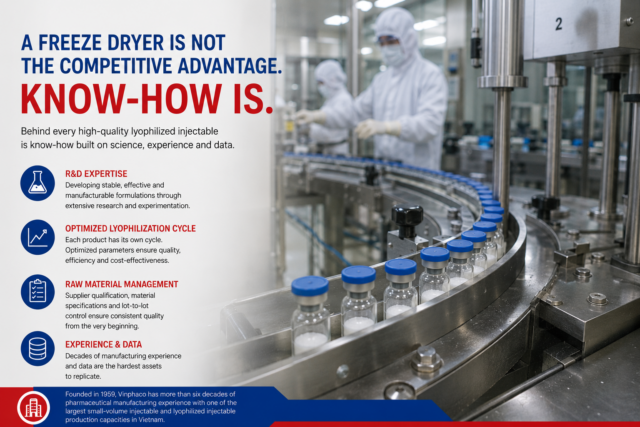
The Role of Lyophilization Equipment
Different manufacturers of lyophilization equipment may use different technologies and equipment configurations.
Even within the same manufacturer, different models may have different:
- Chamber capacities
- Shelf configurations
- Condenser capacities
- Refrigeration systems
- Vacuum systems
- Control systems
- Heat and mass transfer characteristics
However, even when two pharmaceutical manufacturers purchase the same model from the same equipment supplier, their final products may not necessarily have identical quality or manufacturing efficiency.
The reason is that the equipment is only one component of the process.
The actual outcome also depends on how well the manufacturer understands the formulation, process parameters, equipment capabilities, and their interactions.
This is where process development and manufacturing know-how become critical.
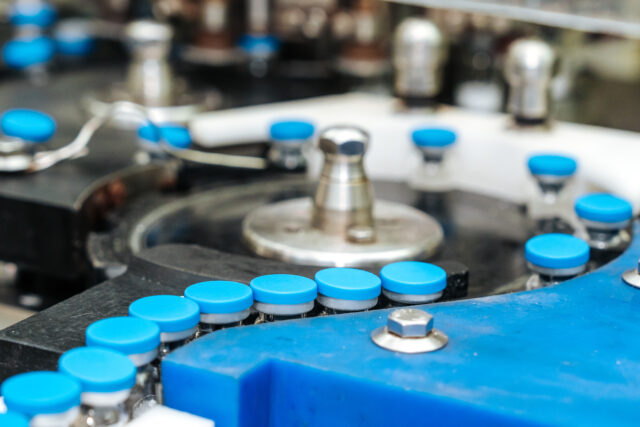
Lyophilization Cycle Development: Where Science Meets Practical Experience
Developing a lyophilization cycle requires more than trial and error.
The R&D team needs to understand the scientific principles behind freezing and drying, including the relationship between formulation properties and process conditions.
Depending on the product, development activities may involve evaluating:
- Freezing behavior
- Critical product temperatures
- Structural stability
- Primary drying conditions
- Secondary drying conditions
- Residual moisture
- Reconstitution performance
- Product appearance
- Stability
However, theoretical knowledge alone is not enough.
A strong development program also requires appropriate laboratory equipment, analytical capabilities, carefully designed experiments, and experienced scientists who can interpret the resulting data.
The objective is not simply to create a cycle that works once.
The goal is to develop a robust and reproducible process that can consistently produce a product meeting predefined quality requirements.
Raw Material Variability and Process Robustness
The challenge in lyophilized injectable manufacturing does not begin at the freeze dryer.
It starts much earlier—with the materials used to make the product.
Pharmaceutical manufacturers generally seek to minimize unnecessary changes to approved raw material suppliers. However, even when the supplier remains unchanged, different batches of the same material may exhibit variability within their approved specifications.
For this reason, raw material management involves more than simply selecting a supplier.
It may include:
- Supplier qualification
- Establishing appropriate material specifications
- Incoming material testing
- Batch-to-batch evaluation
- Risk assessment
- Monitoring material variability
The impact of raw material variability depends on the formulation and process sensitivity.
A change that appears minor from a raw material perspective may potentially influence formulation behavior or process performance.
This is why experienced manufacturers pay close attention to the relationship between material attributes and critical process parameters.
The objective is not to eliminate all variability, which is not realistic.
It is to understand, control, and manage variability appropriately.
Does Every Raw Material Batch Require a Different Lyophilization Cycle?
Not necessarily.
A robust commercial process should be designed to accommodate expected variability in approved raw materials and normal manufacturing conditions.
The objective of process development is therefore not to create a completely different lyophilization cycle for every raw material batch.
Instead, the process should have an appropriate operating range and sufficient robustness to consistently produce a product that meets its predefined quality requirements.
However, if a significant change occurs—for example, a change in the source or characteristics of a critical raw material—the potential impact should be assessed through appropriate quality and change-control systems.
Depending on the nature and significance of the change, additional studies or regulatory actions may be required.
This is one reason why pharmaceutical manufacturing is fundamentally different from simply following a fixed recipe.
A mature manufacturing process is designed to control variability, not pretend that variability does not exist.
Continuous Improvement After Commercialization
The development of a pharmaceutical product does not necessarily end when the product receives regulatory approval and enters commercial manufacturing.
In many ways, another phase begins.
Continuous improvement.
Every commercial batch generates additional manufacturing data.
When data are systematically collected and analyzed, they can help manufacturers better understand process performance and identify opportunities to improve:
- Process efficiency
- Equipment utilization
- Energy consumption
- Cycle time
- Process robustness
- Manufacturing consistency
For example, a manufacturer may identify an opportunity to optimize part of a lyophilization cycle while maintaining product quality and process performance.
Even a relatively small improvement can become meaningful when applied across a large number of commercial batches.
However, in pharmaceutical manufacturing, improvement cannot be separated from quality.
Any change that may affect product quality must be scientifically evaluated and managed through appropriate change-control procedures. Depending on the nature of the change and the regulatory requirements of the relevant market, additional studies or regulatory submissions may also be required. Process changes should be evaluated within an appropriate process validation and lifecycle management framework to ensure that the process remains capable of consistently delivering products that meet predefined quality requirements.
Continuous improvement is therefore not about changing processes simply for the sake of change.
It is about using accumulated data and scientific understanding to make controlled, evidence-based improvements throughout the product lifecycle.
This approach is consistent with the broader pharmaceutical quality system principles promoted by ICH, where continual improvement and science- and risk-based decision-making are important elements of lifecycle management.
Supply Chain Resilience and Alternative Raw Material Sources
Continuous improvement also extends beyond the manufacturing process itself.
Pharmaceutical manufacturers must consider the long-term resilience of their supply chains.
Relying on a single supplier for a critical raw material can create supply risks. At the same time, introducing a new supplier is not as simple as purchasing the same material from another company.
Depending on the material and product, the process may involve:
- Supplier qualification
- Technical assessment
- Material characterization
- Comparative evaluation
- Process impact assessment
- Stability studies, where appropriate
- Regulatory submissions, depending on the market and nature of the change
For this reason, proactive manufacturers may evaluate alternative sources before a supply disruption occurs.
The goal is to ensure that when a change becomes necessary, the technical and regulatory foundation is already in place.
This is another example of how pharmaceutical manufacturing requires long-term thinking.
Why Manufacturing Experience Matters
A pharmaceutical company with sufficient resources can build a new facility, purchase advanced equipment, recruit experienced scientists, or work with specialized laboratories for formulation development and technology transfer.
These investments can significantly accelerate capability building.
However, there is still something that takes time to accumulate.
Manufacturing experience.
A technology transfer can transfer a process.
An SOP can be transferred.
A production line can be installed.
But decades of manufacturing experience cannot simply be transferred overnight.
This experience is built through years of commercial production.
It comes from:
- Manufacturing batches
- Process deviations and investigations
- CAPA activities
- GMP inspections
- Process optimization
- Raw material changes
- Scale-up experience
- Technology transfers
- Stability data
- Continuous improvement
Over time, these experiences become Organizational Knowledge.
And this knowledge becomes more valuable when it does not remain inside the minds of a few experienced individuals.
It must be captured in systems, procedures, data, training, and organizational practices so that knowledge can be retained and passed from one generation to the next.
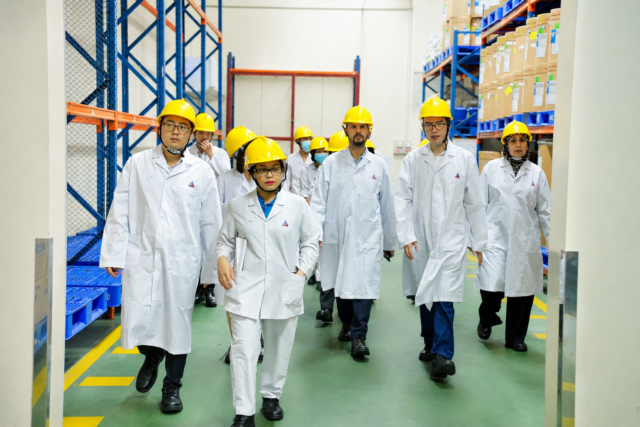
Organizational Knowledge in Pharmaceutical Manufacturing
This is perhaps one of the most underestimated assets of a pharmaceutical manufacturer.
A company may have modern facilities and advanced equipment.who
But the real question is:
How much does the organization understand about the products and processes it has been manufacturing for years?
Organizational knowledge is built when individual experience becomes institutional capability.
It means that lessons learned from one batch can improve the next batch.
Data from years of manufacturing can support better process understanding.
Experience from previous inspections can strengthen the quality system.
And knowledge from previous process improvements can support future development.
The longer a robust process is operated and systematically monitored, the more opportunities there are to generate meaningful process knowledge—provided that the organization has the systems and culture to capture, analyze, and apply that knowledge.
This is particularly important for products that have been commercially manufactured for many years.
A Perspective From Vietnam’s Pharmaceutical Manufacturing Industry
For a pharmaceutical manufacturer established in 1959, the value accumulated over time is not limited to buildings, production lines, or equipment.
It also includes the knowledge built through generations of people working across R&D, Quality Assurance, Quality Control, Manufacturing, Engineering, Regulatory Affairs, and other functions.
This is something I have come to appreciate through my own experience.
Although my background is in clinical pharmacy and I started my career in sales and marketing, I have been fortunate to become involved in activities related to R&D, manufacturing, factory investment, and regulatory inspections.
As someone working in international business development, this is also why I feel confident when speaking with international partners.
Not because I have all the answers.
But because I know that behind every commitment is a multidisciplinary team—from R&D, QA, QC, Manufacturing, Engineering, Regulatory Affairs, and many others—working together with professionalism, responsibility, and a shared commitment to quality.
That, to me, is the true value of Organizational Knowledge.
Conclusion
Lyophilized injectable manufacturing is much more than operating a freeze dryer.
It is the integration of:
- Scientific understanding
- Formulation and process development
- Equipment capability
- Raw material control
- Manufacturing experience
- Quality systems
- Regulatory knowledge
- Data-driven continuous improvement
A modern freeze dryer can be purchased.
A new facility can be built.
A process can be transferred.
But the organizational knowledge required to consistently manufacture high-quality pharmaceutical products is built over time.
Machines depreciate over time. Manufacturing knowledge does the opposite.
For pharmaceutical manufacturers, that accumulated knowledge may ultimately be one of the most difficult—and most valuable—competitive advantages to replicate.