
 English
 العربية
 Français
 Русский
 Español
 Uzbek
Uzbek
 Myanmar
This article updates the latest scientific evidence and treatment guidelines regarding the role of glucocorticoids in the treatment of severe community-acquired pneumonia (sCAP).
Pneumonia is an acute inflammatory disease of the lung parenchyma, commonly caused by pathogenic microorganisms such as bacteria, viruses, or fungi. The inflammatory process leads to infiltration of inflammatory cells and pulmonary edema (Figure 1). Despite many advances in diagnosis and treatment, pneumonia remains one of the leading causes of morbidity and mortality worldwide, particularly in the elderly and patients with underlying diseases.
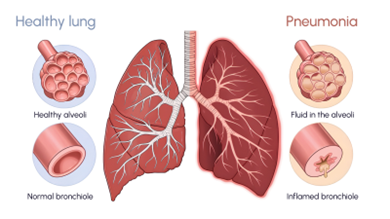
Figure 1. Comparison of a healthy lung and lung with pneumonia
The disease may rapidly progress to serious complications such as septic shock and acute respiratory distress syndrome (ARDS), both of which have high mortality rates and often require intensive care. In the management of bacterial pneumonia, antibiotics remain the cornerstone of treatment, but adjunctive therapies, including corticosteroids, are increasingly gaining attention, especially in cases of severe community-acquired pneumonia (CAP). Identifying the optimal treatment strategy to reduce the disease burden and improve patient outcomes remains a primary priority in clinical practice.
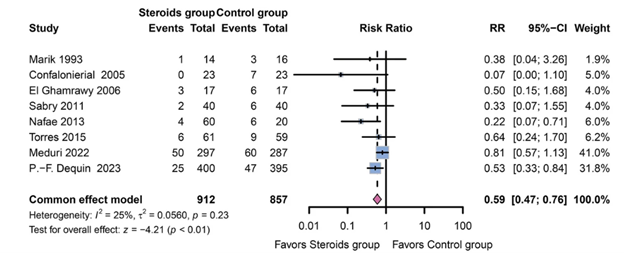
In 2025, Gu et al. published a systematic review and meta-analysis conducted on randomized controlled trials (RCTs) to address this question. The study was conducted according to PRISMA guidelines, selecting RCTs that evaluated the efficacy of glucocorticoids in adult sCAP patients, excluding observational studies, case reports, as well as immunocompromised patients or those who had prior exposure to systemic corticosteroids.
A total of 8 RCTs involving 1,769 patients were included in the analysis. Results demonstrated that the glucocorticoid group had a significantly lower mortality rate compared to the control group (RR=0.59; 95%CI 0.47–0.76; p<0.01). The most pronounced benefit was observed in the hydrocortisone treatment group, with a mortality rate of only 6.3% compared to 14.6% in the control group (RR=0.43; p<0.01), whereas methylprednisolone did not show a significant difference. Furthermore, moderate doses (140–280 mg hydrocortisone/day) were clearly associated with reduced mortality, while low or excessively high doses did not confer similar benefits.
In addition to clinical evidence, the latest treatment guidelines also emphasize the role of glucocorticoids in the management of sCAP. The French Infectious Disease Society (SPILF) and the French Society of Respiratory Diseases(SPLF), in coordination with multiple specialty societies, published an updated recommendation for the management of CAP in adults, replacing the 2010 version. The new recommendations highlight several key topics: initial antibiotic selection, combination therapy, indication for anti-Pseudomonas aeruginosa beta-lactam, duration of antibiotic treatment, and notably, the role of systemic corticosteroids. This is a synthesis of the latest scientific evidence aimed at optimizing CAP patients care.
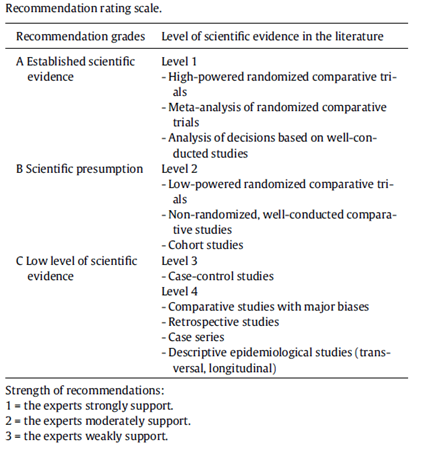
Figure 3. Scale for grading recommendations and levels of scientific evidence
The 2025 guidelines from SPILF and SPLF provide specific recommendations, classified according to the level of scientific evidence (Figure 3):
- Non-severe CAP (outpatient or inpatient): Corticosteroids are not recommended (Level A-2).
- Severe CAP (patients admitted to the ICU): The use of hydrocortisone hemisuccinate is recommended, initiated within 24 hours after the onset of severe signs, except in cases of myelosuppression, aspiration pneumonia, or influenza pneumonia. The initial dose is 200 mg/day, reassessed on Day 4 to consider dose reduction, with a total duration of treatment ranging from 8 to 14 days (Level A-1).
In parallel with scientific evidence, Vinphaco currently provides quality glucocorticoid options such as VINPHASON (Hydrocortisone 100 mg), VINSOLON (Methylprednisolone 40 mg), Prednisolone 30 mg/1 ml, and Dexamethasone Phosphate 4 mg/1 ml, contributing to supporting healthcare teams in enhancing treatment efficacy and improving patient health.
References:
- Gu, X., Yang, P., Yu, L. et al. Glucocorticoids can reduce mortality in patients with severe community-acquired pneumonia: a systematic review and meta-analysis of randomized controlled trials. Eur J Med Res 30, 215 (2025). https://doi.org/10.1186/s40001-025-02487-6
- Fujishima, S. Current corticosteroid therapeutic strategy for community-acquired pneumonia in adults: indications, dosage, and timing. j intensive care13, 37 (2025). https://doi.org/10.1186/s40560-025-00809-8
- Update of guidelines for management of Community Acquired pneumonia in adults by the French Infectious Disease Society (SPILF) and the French-Speaking Society of Respiratory Diseases (SPLF): Endorsed by the French intensive care society (SRLF), the French microbiology society (SFM), the French radiology society (SFR) and the French emergency society (SFMU), Respiratory Medicine and Research, Volume 87, 2025