
 العربية
 Français
 Português
 Русский
 Español
 Uzbek
Uzbek
 Myanmar
Description:
H. pylori infection is a globally prevalent bacterial infection that causes dyspepsia, peptic ulcers, and gastric cancer. In 2024, the American College of Gastroenterology (ACG) issued a clinical practice guideline (CPG) using the GRADE methodology to evaluate 11 PICO questions and provide key recommendations for H. pylori treatment in both treatment-naive and refractory patients. The guideline also covers who should be tested, post-treatment testing requirements, the role of antibiotic susceptibility testing in regimen selection, and research priorities to address knowledge gaps in H. pylori management in North America.
Content:
Helicobacter pylori (H. pylori) is a spiral-shaped bacterium found in the lining of the stomach. It thrives in the acidic environment of the stomach. While many people remain asymptomatic, H. pylori can lead to serious health problems such as chronic gastritis, peptic ulcers, and even gastric cancer.
H. pylori infection remains one of the most common chronic bacterial infections in humans worldwide. It is the leading cause of infection-related cancer globally and has been classified as a Group I carcinogen by the World Health Organization (WHO) due to its strong association with gastric cancer. In North America, it affects 30%–40% of the population.
In 2024, the Clinical Practice Guideline (CPG) from the American College of Gastroenterology (ACG) was released to provide practical, actionable recommendations for managing H. pylori infection in North America. These updated treatment guidelines emphasize the importance of effective treatment regimens, particularly in the context of rising antibiotic resistance.
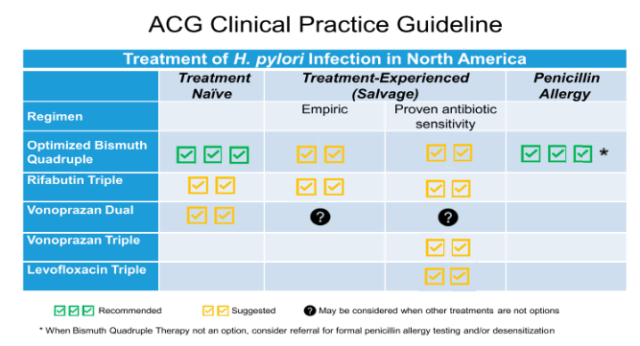
Key Updates in the ACG H. pylori Treatment Guidelines:
The updates focus on treatment strategies for both first-time (treatment-naive) and persistent (refractory) infections, aiming to improve treatment efficacy and overcome antibiotic resistance.
First-line Treatment for Treatment-Naive Patients:
- Bismuth Quadruple Therapy (BQT): Combines a proton pump inhibitor (PPI), bismuth, tetracycline, and metronidazole. This is the top recommended first-line treatment due to its high effectiveness.
- Rifabutin Triple Therapy: A novel regimen combining rifabutin (a potent antibiotic), amoxicillin, and PPI. A strong alternative for initial treatment.
- PCAB and Amoxicillin Dual Therapy: Combines a potassium-competitive acid blocker (PCAB) with amoxicillin. An effective first-line option, particularly in suspected clarithromycin resistance.
- PCAB-Clarithromycin Triple Therapy: For patients with unknown clarithromycin resistance status, this regimen (PCAB, clarithromycin, and PPI) is preferred over traditional PPI-based therapies.
Treatment for Refractory H. pylori Infections:
For patients who fail initial therapy, the following options are recommended:
- Bismuth Quadruple Therapy (BQT): Remains the top recommendation for those not previously treated with BQT.
- Rifabutin Triple Therapy: Recommended for patients with persistent infections who have previously received BQT. A powerful alternative regimen.
- Levofloxacin Triple Therapy: For H. pylori strains sensitive to levofloxacin, this regimen (levofloxacin, amoxicillin, and PPI) is recommended. Especially useful after failure of BQT or Rifabutin therapy.
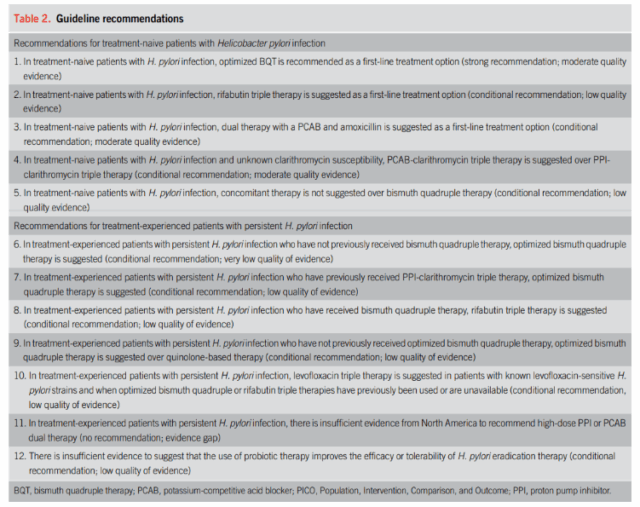
Detailed recommendations are presented in Table 2 of the guideline.
Additional Recommendations:
The guideline also addresses:
- Populations who should be tested for H. pylori
- Requirements for post-treatment testing
- The role of antibiotic susceptibility testing in regimen selection
- Research priorities to bridge knowledge gaps in H. pylori management in North America
Conclusion:
The new ACG treatment guideline emphasizes optimal regimen selection, individualized therapy, and antibiotic resistance management strategies to enhance H. pylori eradication outcomes. Adhering to these recommendations is critical to prevent severe complications such as ulcers and gastric cancer.
Supporting Pharmaceutical Options:
Given the essential role of PPI medications in H. pylori treatment regimens, Vinphaco offers high-quality international-standard PPI products, including:
- VINXIUM (Esomeprazole 40mg) – lyophilized powder for injection
- OMEPRAZOLE – Vitapure (Omeprazole sodium 40mg)
- PANTOPRAZOLE – Vitapure (Pantoprazole 40mg)
- ESOMEPRAZOLE – Vitapure (Esomeprazole 40mg)
These products ensure effective, safe, and cost-efficient treatment for H. pylori-infected patients.
For more details, you can refer to the full ACG guideline at: Am J Gastroenterol 2024;119:1730–1753.
https://doi.org/10.14309/ajg.0000000000002968; published online September 4, 2024.