
 العربية
 Français
 Português
 Русский
 Español
 Uzbek
Uzbek
 Myanmar
Description:
Antibiotic resistance is a serious global public health threat, as many conventional antibiotics are losing effectiveness against multidrug-resistant bacteria. This article explores the role of antimicrobial peptides (AMPs), their synergistic mechanisms when combined with antibiotics, and the promising preclinical evidence that may shape future treatment strategies.
Content:
Antibiotic resistance (AMR) has emerged as a critical global health challenge. The rise of multidrug-resistant bacterial strains has rendered many traditional antibiotics less effective, significantly limiting treatment options for infectious diseases. Innovative approaches that not only enhance the efficacy of existing antibiotics but also prevent further resistance development are urgently needed to address this growing crisis.
One prominent strategy is combination therapy, which pairs antibiotics with antimicrobial peptides (AMPs). AMPs are naturally occurring molecules found in many organisms, including humans, with the ability to rapidly kill bacteria, induce minimal resistance, modulate immune responses, and promote wound healing.
Unlike traditional antibiotics, which typically target bacterial enzymes or biosynthesis pathways, AMPs primarily act on the bacterial cell membrane, disrupting lipid structures and compromising membrane integrity. When combined with antibiotics, these two agents often demonstrate strong synergistic effects.
In Vitro Studies on Synergistic Effects Between AMPs and Antibiotics
In vitro studies have identified multiple mechanisms explaining the synergy between AMPs and antibiotics (Figure 1):
- Increased Membrane Permeability:
AMPs disrupt bacterial membranes, allowing antibiotics to penetrate more easily. For example, combining peptides PMAP-36 and PRW4 with aminoglycosides enhances intracellular antibiotic delivery, resulting in synergistic antibacterial effects. - Biofilm Inhibition:
AMPs can break down biofilms, making bacteria more susceptible to antibiotics. For instance, Peptide Pt5-1c in combination with vancomycin or streptomycin not only disrupts biofilms but also restores antibiotic sensitivity in multidrug-resistant strains. - Increased Antibiotic Sensitivity:
Some AMPs (e.g., SPR741) sensitize bacteria to antibiotics—even in resistant strains—by altering membrane permeability or stress responses. - Interference with Resistance Mechanisms:
AMPs may inhibit efflux pumps or modulate gene expression related to resistance, reducing the likelihood of resistance development and improving antibiotic efficacy.
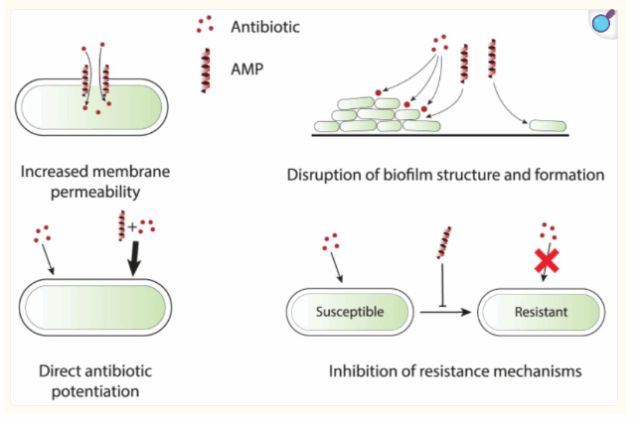
Figure 1:
Four major synergistic mechanisms observed in in vitro studies involving AMP-antibiotic combinations.
In Vivo Studies on AMP-Antibiotic Synergy
In vivo studies are essential for developing effective infection treatments, as they reflect the complexity of living organisms. These studies reveal unique synergy mechanisms not observed in vitro, particularly those involving host responses (Figure 2):
- Immunomodulation and Anti-inflammatory Effects:
AMPs can enhance immune responses, promoting monocyte/macrophage recruitment to infection sites, reducing inflammation, and lowering cytokine production—improving clinical outcomes. For example, PMAP-36 combined with tetracycline significantly increased survival in a murine infection model. - Slowing the Development of Resistance:
This is a key advantage, allowing AMPs to preserve antibiotic effectiveness and delay the emergence of resistant strains. PMAP-36 has demonstrated this effect against tetracycline-resistant E. coli in pigs. - Wound Healing and Tissue Regeneration:
Some AMP-antibiotic combinations inhibit biofilm formation (e.g., Tachyplesin III with piperacillin-tazobactam on ureteral stents) and reduce MRSA bacterial load in wounds and systemic infections, supporting tissue recovery.
Despite these promising findings, translating in vivo results into clinical practice remains complex and requires additional preclinical evaluation and clinical trials to assess safety, efficacy, and pharmacokinetics in humans.
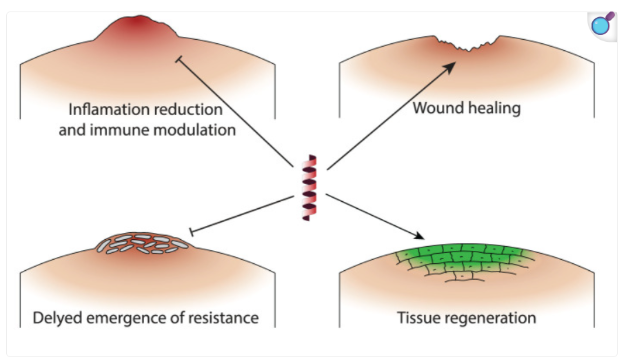
Figure 2:
Key mechanisms through which AMP-antibiotic combinations exhibit unique effects in in vivo models.
Potential and Challenges
Potential:
- A promising strategy against multidrug-resistant bacteria
- Strong antibacterial efficacy with low risk of resistance
- Supports wound healing and immune modulation
- Can be optimized using peptide engineering, computational modeling, and AMP databases
Challenges:
- Difficult transition from in vitro findings to clinical application
- Lack of large-scale clinical trials
- Incomplete understanding of synergistic mechanisms
- Risk of resistance development to AMPs in some microorganisms
- Need for more data on AMP stability, toxicity, and long-term efficacy
Currently, AMP-antibiotic combination therapy remains mostly in the preclinical or model research phase, but it is considered a promising future direction. This strategy may enhance treatment efficacy, reduce resistance, and optimize the use of available antibiotics.
While awaiting stronger clinical evidence, rational use of existing antibiotics remains the foundation of infection control. Vinphaco provides several key antibiotics such as:
- Amikacin – Vitapure (Amikacin 500mg/2ml)
- Lincomycin – Vitapure (Lincomycin 600mg/2ml)
- VANCOMYCIN – Vitapure (Vancomycin HCl 1000mg)
- VANCOMYCIN (Vancomycin 500mg)
These products contribute to current treatment needs and may be future candidates for AMP combination therapies, expanding clinical options and applications.
References:
- Taheri-Araghi S. Synergistic action of antimicrobial peptides and antibiotics: current understanding and future directions. Front Microbiol. 2024 Jul 31;15:1390765. doi: 10.3389/fmicb.2024.1390765. PMID: 39144233; PMCID: PMC11322369.
- Interagency Coordination Group on Antimicrobial Resistance. No time to wait: securing the future from drug-resistant infections. Report to the Secretary General of the United Nations (2019).
- Wang, Zeyun, et al. Synergistic interaction of PMAP-36 and PRW4 with aminoglycoside antibiotics and their antibacterial mechanism. World J Microbiol Biotechnology 2014;30(12):3121–3128.
- Duan, Huimin, et al. Synergistic effect and antibiofilm activity of an antimicrobial peptide with traditional antibiotics against multi-drug resistant bacteria. Microbial Pathogenesis 158 (2021): 105056