
 العربية
 Français
 Português
 Русский
 Español
 Uzbek
Uzbek
 Myanmar
Description:
The World Health Organization (WHO) has released its 2024 update of the Bacterial Priority Pathogens List (BPPL), which identifies 15 families of antibiotic-resistant bacteria, categorized into Critical, High, and Medium priority levels. This list aims to guide the development of urgently needed new treatments and countermeasures to prevent the spread of antimicrobial resistance (AMR).
Main Text
Global AMR Burden
Antimicrobial resistance (AMR) is among the most serious global health threats today. It directly causes over 1.2 million deaths annually and undermines the effectiveness of many essential antibiotics. In 2021, AMR was associated with 4.71 million deaths, including 1.14 million directly attributable to resistance. While AMR-related mortality decreased by over 50% in children under 5, it increased by more than 80% in those aged 70 and above. Major contributors include MRSA and carbapenem-resistant Gram‑negative organisms.
Projections forecast that by 2050, AMR could directly cause 1.91 million deaths and contribute to over 8.22 million deaths globally, particularly in South Asia and Latin America. The burden of AMR is expected to rise especially in low‑ and middle‑income countries, driven by antibiotic misuse, weak infection control, and lack of new drugs. Without global action, AMR could threaten the gains of modern medicine.
WHO BPPL 2024 Overview
In response, WHO has updated its Bacterial Priority Pathogens List (BPPL) in 2024, building on the 2017 version. This updated list is intended to steer research, drug development, and international collaboration. The prioritized pathogens are grouped into three levels:
- Critical priority
- High priority
- Medium priority
WHO emphasizes a comprehensive approach encompassing prevention, accurate diagnostics, and appropriate treatment to mitigate the global AMR burden.
Changes from 2017 to 2024
Compared to 2017, BPPL 2024 has removed five bacterial–antibiotic combinations and added four new ones. Significantly, third‑generation cephalosporin‑resistant Enterobacterales have been added to the critical priority list, underscoring their growing burden—especially in low- and middle-income countries.
Conversely, carbapenem‑resistant Pseudomonas aeruginosa (CRPA) has been downgraded to high priority, reflecting reported global declines in resistance. Nonetheless, sustained investment in R&D and control measures remains essential due to regional CRPA burden.
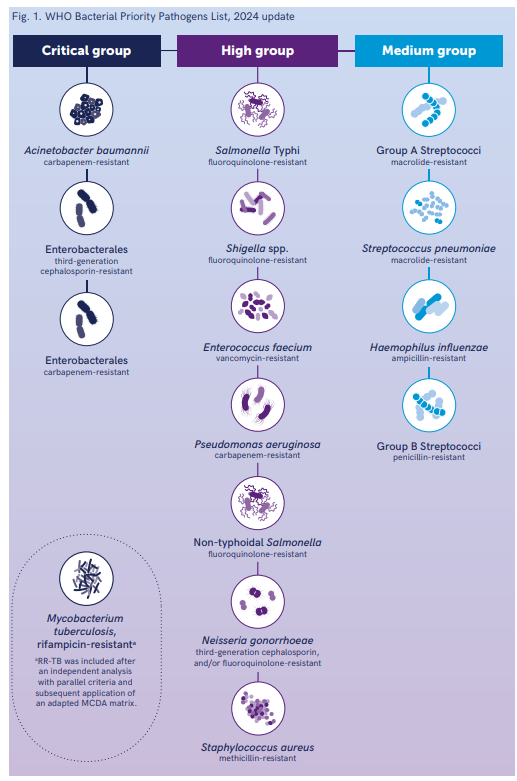
WHO BPPL 2024 Pathogens List (see Figure 1)
Critical Priority
- Acinetobacter baumannii, carbapenem‑resistant
- Enterobacterales, third‑generation cephalosporin‑resistant
- Enterobacterales, carbapenem‑resistant
- Mycobacterium tuberculosis, rifampicin‑resistant
(Included after a separate multi‑criteria decision analysis process)
High Priority
- Salmonella Typhi, fluoroquinolone‑resistant
- Shigella spp., fluoroquinolone‑resistant
- Enterococcus faecium, vancomycin‑resistant
- Pseudomonas aeruginosa, carbapenem‑resistant
- Non‑typhoidal Salmonella, fluoroquinolone‑resistant
- Neisseria gonorrhoeae, resistant to third‑generation cephalosporins and/or fluoroquinolones
- Staphylococcus aureus, methicillin‑resistant (MRSA)
Medium Priority
- Group A Streptococcus, macrolide‑resistant
- Streptococcus pneumoniae, macrolide‑resistant
- Haemophilus influenzae, ampicillin‑resistant
- Group B Streptococcus, penicillin‑resistant
Strategic Implications
The revisions between 2017 and 2024 highlight the dynamic nature of AMR, emphasizing the need for timely, tailored responses. While BPPL offers a valuable global framework, regional and national adaptation ensures relevancy given local variations in pathogen prevalence and resistance patterns.
The WHO BPPL initiative is central to guiding R&D investment and international coordination, aiming to support antibiotic developers, research institutions, funding entities, and policymakers in designing and implementing targeted AMR interventions.
Access the full WHO BPPL 2024 report here:
https://iris.who.int/bitstream/handle/10665/376776/9789240093461-eng.pdf
Vinphaco’s Role
Amid escalating AMR threats, Vinphaco remains committed to developing high-quality antibiotic formulations to support effective infectious disease treatment. Key products include:
- Amikacin – Vitapure (Amikacin 500 mg/2 ml) – targeting Gram‑negative pathogens
- Lincomycin – Vitapure (Lincomycin 600 mg/2 ml) – targeting Gram‑positive organisms
- VANCOMYCIN – Vitapure (Vancomycin HCl 1000 mg)
- VANCOMYCIN (Vancomycin 500 mg)
These products address current clinical needs and may support future strategies combining antibiotics with new technologies or therapies to address AMR challenges.
References
- Naghavi, M., et al. Global burden of bacterial antimicrobial resistance 1990–2021: a systematic analysis with forecasts to 2050. The Lancet, 404(10459), 1199–1226 (2024).
- WHO. 2024 Bacterial Priority Pathogens List (BPPL).
- WHO News Release, May 17, 2024: WHO updates list of drug-resistant bacteria most threatening to human health.
- Full report – WHO BPPL 2024 PDF.