
 العربية
 Français
 Português
 Русский
 Español
 Uzbek
Uzbek
 Myanmar
In the era of rapid medical advancement, bacterial and viral respiratory infections remain at the forefront of public health priorities. However, another “silent killer” is steadily rising and imposing a massive healthcare burden: pulmonary fungal diseases. With the expansion of high-risk patient populations and alarming mortality rates, pulmonary fungal infections now demand closer attention from the medical community as well as intensified research efforts from the pharmaceutical industry.
1. Global Overview: Epidemiological Data That Speaks Volumes
The lungs are the most commonly targeted organs in invasive fungal infections. According to the Global Burden of Disease (GBD) 2021 study, an estimated 5.62 million pulmonary fungal infection cases occur annually, resulting in approximately 45,542 deaths per year, with an age-standardized mortality rate of 0.56 per 100,000 population. By 2044, deaths caused by invasive pulmonary fungal infections (PFIs) are projected to exceed 87,000 cases, indicating a trend that cannot be overlooked.
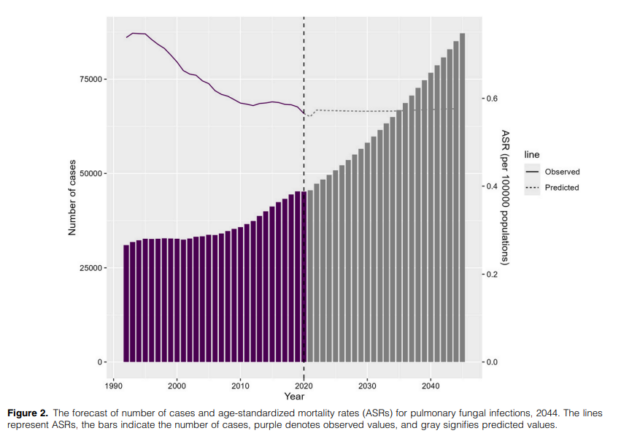
Figure 2. Forecast of the number of cases and age-standardized mortality rates (ASRs) for pulmonary fungal infections in 2044. The lines represent ASRs, the bars indicate the number of cases, purple denotes observed values, and gray signifies projected values.
When considering the broader burden of invasive fungal infections overall, the situation becomes significantly more severe. Recent medical estimates suggest that each year there are approximately 6.5 million invasive fungal infections, leading to around 3.8 million deaths, of which 2.5 million (68%) are directly attributable to fungal pathogens.
Global Epidemiological Burden by Major Pulmonary Fungal Diseases
| Disease | Annual Cases | Annual Deaths | Case Fatality Rate | Main High-Risk Groups |
|---|---|---|---|---|
| Invasive Pulmonary Aspergillosis (IPA) | >2,113,000 | 1,801,000 | 85.2% | COPD patients, ICU patients, lung cancer, hematologic malignancies |
| Pneumocystis Pneumonia (PCP) | 505,000 | 214,000 | 42.4% | Immunocompromised individuals (HIV, corticosteroid use, etc.) |
| Chronic Pulmonary Aspergillosis (CPA) | 1,837,272 | 340,000 | 18.5% | Patients with structural lung damage (post-TB, bronchiectasis) |
| Fungal Asthma | ~11,500,000 | 46,000 | ~0.4% | Patients with poorly controlled asthma |
2. At-Risk Populations: A Shifting Epidemiological Landscape
Previously, pulmonary fungal infections were primarily associated with severely immunocompromised patients, such as organ transplant recipients, individuals with advanced HIV/AIDS, or those with profound neutropenia. Today, however, the epidemiological profile has shifted significantly, with a growing pool of high-risk populations:
Patients with Chronic Underlying Diseases
Especially those with chronic obstructive pulmonary disease (COPD), lung cancer, or critically ill patients in intensive care units (ICU).
Consequences of Viral Respiratory Outbreaks
Respiratory viruses can cause severe epithelial damage and immune dysregulation. Moreover, the widespread use (and misuse) of corticosteroids during treatment exacerbates susceptibility, creating favorable conditions for fungal invasion.
Demographic and Environmental Factors
Age is an independent risk factor, with significantly higher incidence and mortality observed in individuals over 50 years old. Additionally, climate change is altering ecosystems, enabling fungal spores to adapt to higher temperatures and expand their geographic distribution.
3. Challenges in Diagnosis and Treatment
Clinical management of pulmonary fungal infections faces major hurdles, posing complex challenges for healthcare professionals:
The “Blind Spot” in Early Diagnosis
Clinical manifestations are often non-specific and may overlap with exacerbations of underlying diseases (such as COPD), bacterial or viral pneumonia, or even cardiovascular events. Traditional culture methods are limited by low sensitivity (30–40%) and long turnaround times.
Furthermore, limited access to advanced diagnostic tools—such as Galactomannan antigen testing, Beta-D-glucan assays, and PCR techniques—in low- and middle-income countries prevents patients from receiving timely treatment during the critical therapeutic window.
Barriers in Treatment and Rising Drug Resistance
Current antifungal therapies require prolonged treatment duration, often associated with significant toxicity and complex drug-drug interactions.
More concerning is the global emergence of antifungal resistance, particularly due to the extensive use of azole fungicides in agriculture, which has led to the rise of resistant strains such as azole-resistant Aspergillus. This multidrug resistance significantly reduces treatment efficacy and drives mortality rates even higher.
4. The Role and Mission of Modern Pharmaceutical Industry
To combat this “silent pandemic,” pharmaceutical companies play a pivotal role in reshaping the landscape through innovative Research & Development (R&D) strategies:
Development of Next-Generation Antifungal Agents
The global drug pipeline is introducing promising candidates with novel mechanisms of action, aiming to overcome resistance and improve safety profiles. Key innovative molecules include:
- Rezafungin – a next-generation echinocandin with an ultra-long half-life
- Ibrexafungerp – the first oral glucan synthase inhibitor
- Fosmanogepix – targeting the Gwt1 enzyme
- Olorofim – inhibiting the pyrimidine biosynthesis pathway
Optimization of Drug Delivery Systems
Advancements in inhalable antifungal formulations (e.g., amphotericin B and next-generation azoles) enable targeted drug delivery directly to lung tissues, maximizing local drug concentration while minimizing systemic toxicity.
Toward a New Era of Fungal Vaccines
Although no antifungal vaccine has yet been commercially approved for humans, this remains a highly promising research frontier. Advances in artificial intelligence (AI), biochips, and immunoinformatics are expected to significantly accelerate vaccine development in the near future.
Conclusion
Pulmonary fungal diseases are no longer rare infections at the margins of healthcare systems—they have become a major global public health challenge, causing substantial mortality and economic burden.
Continuous updates on epidemiological data, improved clinical awareness, and accelerated R&D efforts in rapid diagnostics and next-generation antifungal therapies are essential to addressing this growing threat.
References
- Xia, Ying, et al. “Global, regional, and national burden of pulmonary fungal infections 1990–2021.” American journal of respiratory and critical care medicine 211.6 (2025): 1007-1017.
- Jaggi, Tavleen Kaur, et al. “Fungal lung disease.” European Respiratory Journal 64.5 (2024).