
 English
 العربية
 Français
 Português
 Español
 Uzbek
Uzbek
 Myanmar
Latest Evidence from Meta-Analysis: Glucocorticoids Reduce Mortality and Improve Outcomes in Severe Community-Acquired Pneumonia (sCAP)
This article provides an update on the latest scientific evidence regarding the role of glucocorticoids in the treatment of severe community-acquired pneumonia (sCAP). Findings from a meta-analysis involving 1,769 patients suggest that glucocorticoids—particularly medium-dose hydrocortisone—can help reduce mortality, shorten mechanical ventilation duration and ICU stay, without increasing the risk of serious complications. These results provide strong support for considering glucocorticoids as a promising adjunct therapy in the management of sCAP patients.
Community-acquired pneumonia (CAP) is one of the most common respiratory infections, with a high incidence rate. In the United States alone, over 1.5 million adults are hospitalized each year due to CAP, with mortality rates ranging from 2% to 20%, and up to 50% among those admitted to intensive care units (ICUs). Severe community-acquired pneumonia (sCAP), in particular, is often associated with serious infections, septic shock, or respiratory failure, leading to mortality rates as high as 30% in patients requiring invasive mechanical ventilation, and approximately 40% in those with septic shock.
Glucocorticoids, known for their potent anti-inflammatory and immunomodulatory effects, have long been investigated for their potential to improve clinical outcomes in CAP. While previous data suggested possible benefits in reducing mortality and improving overall treatment results, the effectiveness of glucocorticoids specifically in sCAP remains controversial. Earlier analyses—such as a 2018 meta-analysis—did not demonstrate clear benefits, whereas more recent clinical trials have shown contrasting outcomes, suggesting reduced mortality and mechanical ventilation needs. This inconsistency underscores the need for a more comprehensive review of current evidence.
In 2025, Gu and colleagues published a systematic review and meta-analysis aimed at addressing this question. Conducted in accordance with PRISMA guidelines, the study included randomized controlled trials (RCTs) assessing the efficacy of glucocorticoids in adult patients with sCAP. Observational studies, case reports, and studies involving immunocompromised patients or those previously treated with systemic corticosteroids were excluded. The primary outcome of interest was all-cause mortality (in-hospital or at day 28/30), with secondary outcomes including duration of mechanical ventilation, ICU stay, hospital stay, and adverse events.
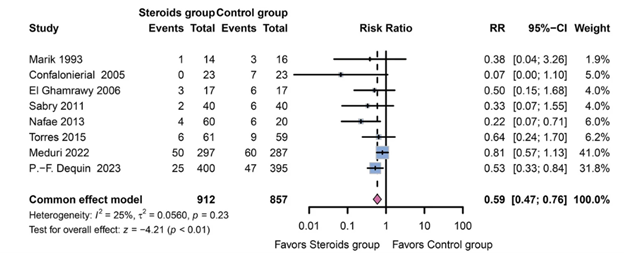
A total of 8 RCTs involving 1,769 patients were included in the analysis. The results showed a significantly lower mortality rate in the glucocorticoid group compared to the control group (RR=0.59; 95% CI: 0.47–0.76; p<0.01). The most pronounced benefit was observed in patients treated with hydrocortisone, where the mortality rate was only 6.3%, compared to 14.6% in the control group (RR=0.43; p<0.01). In contrast, methylprednisolone did not show a significant difference. Additionally, medium-dose hydrocortisone (140–280 mg/day) was clearly associated with reduced mortality, whereas lower or higher doses did not yield similar benefits.
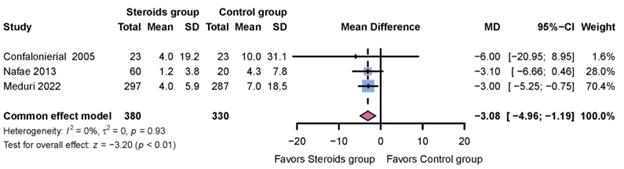
In addition to reducing mortality, glucocorticoids also improved several important clinical outcomes. The duration of mechanical ventilation was significantly reduced by an average of 3.08 days (95% CI: −4.96 to −1.19, p < 0.01), and ICU length of stay was shortened by an average of 1.16 days (95% CI: −1.61 to −0.71, p < 0.01) compared to the control group. However, there was no significant difference in overall hospital stay duration.
In terms of safety, glucocorticoid use was associated with an increased risk of hyperglycemia (37.5% vs. 29.6%; RR = 1.28; p = 0.0002), but it did not lead to a higher risk of gastrointestinal bleeding or secondary infections.
The latest meta-analysis has provided strong evidence that glucocorticoids—particularly medium-dose hydrocortisone administered for 5–7 days—significantly reduce mortality and improve outcomes in patients with severe community-acquired pneumonia (sCAP). While further research is needed to optimize the choice of agent, dosage, and treatment duration, glucocorticoids remain a promising adjunctive therapy for this high-risk patient group.
In parallel with the growing scientific evidence, Vinphaco now offers a range of high-quality glucocorticoid options, including VINPHASON (Hydrocortisone 100 mg), VINSOLON (Methylprednisolone 40 mg), Prednisolone 30 mg/1 ml, and Dexamethasone Phosphate 4 mg/1 ml—supporting healthcare professionals in enhancing treatment outcomes and improving patient health.
References:
Gu, X., Yang, P., Yu, L. et al. Glucocorticoids can reduce mortality in patients with severe community-acquired pneumonia: a systematic review and meta-analysis of randomized controlled trials. Eur J Med Res 30, 215 (2025). https://doi.org/10.1186/s40001-025-02487-6